Programs
Cant de Ramon: A Sound Portrait of Ramon Llull (1232-1316)
“The bird sang in the garden of the Beloved. A friend came and said to the bird: ‘If we cannot understand one another through language, let us understand one another through love; for in your song, my Beloved is revealed to mine eyes”
Ramon Llull (1232-1316)
Ramon Llull (1232–1316): The Philosopher, Mystic, and Pioneer of Dialogue
Ramon Llull, a Catalan polymath, is considered one of the most important intellectual figures of the 13th and 14th centuries. Born in Mallorca, Llull’s life was marked by profound spiritual transformation and intellectual innovation. A devout Christian, Llull initially lived a life of worldly pleasures but underwent a dramatic conversion that set him on a path of religious and intellectual pursuits. His dedication to both theology and philosophy led him to create the Ars Magna (The Great Art), a complex system of logic aimed at proving Christian truths through reason and dialogue.
Llull’s contributions to thought were not confined to philosophy alone. He believed in the power of rational discourse to bridge divides between religions, especially between Christianity and Islam. He spent much of his life seeking to engage in interfaith dialogue, proposing a mission of peaceful conversion through reason and love rather than warfare. This vision of a more intellectual and compassionate crusade was revolutionary for its time.
Although not a musician himself, Llull’s influence extended to various aspects of medieval culture, including music. He was a contemporary of the Franciscans and Cistercians, whose devotion to simplicity, spirituality, and piety resonated with his own religious ideals. In this concert, we explore the musical landscape of Llull’s era, showcasing works that reflect the intellectual, spiritual, and cultural environment in which he lived. These compositions, from Gregorian chant to the vibrant polyphony of the time, evoke the atmosphere of the medieval court and the deeply religious, yet intellectually adventurous, world that Llull inhabited.
As we delve into the sounds of the 13th and early 14th centuries, we are reminded of Llull’s legacy: a man who sought not only to explore the divine through reason but also to bring humanity closer together through love, understanding, and dialogue.
VETERA
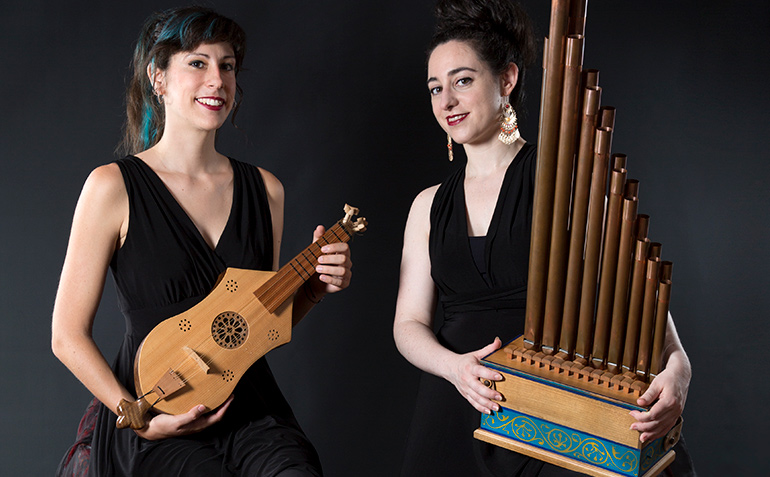
The Portative Organ and the Citole were highly popular instruments in the 13th and 14th centuries. When combined, they complement each other with contrasting timbres: one sustaining rich, colourful notes, while the other adds rhythmic character and energy through the movement of the plectrum. Most of the music that has survived to this day is vocal, and although instrumental parts for vocal pieces have not been preserved, we have evidence that these instruments were used to accompany the voices.
In addition to performing purely instrumental pieces (for which some manuscripts have been preserved), we also explore the sonic possibilities of these two instruments through vocal works in their instrumental versions.
Maria de Mingo
She holds a degree in Performance of Plucked String Instruments from the Higher Conservatory of Music of Aragón and a Master’s in Music Education. She has furthered her studies through various seminars and courses focused on Medieval music and medieval plucked instruments such as the citole and the gittern. As a performer of Medieval music, she has appeared with various ensembles and projects, including Na Rota do Peregrino and Magister Petrus, both directed by Dr. Mauricio Molina; Medievall Ensemble, Hebenko ta Hanko, and Compromiso de Caspe. She frequently collaborates with EGERIA on their different programmes, with whom she recorded their latest EP, Sanctum Virum Ysidorum.
She is also a member of Ipsum Femina and the Vetera Duo, a project with Cristina Alís where they research, reconstruct, and perform music from the 13th and 14th centuries. Additionally, María combines her concert activities with teaching, having been invited as a lecturer on Medieval plucked instruments at various editions of the Mirabilia Medieval Music Course at the Cathedral of Cuenca.